
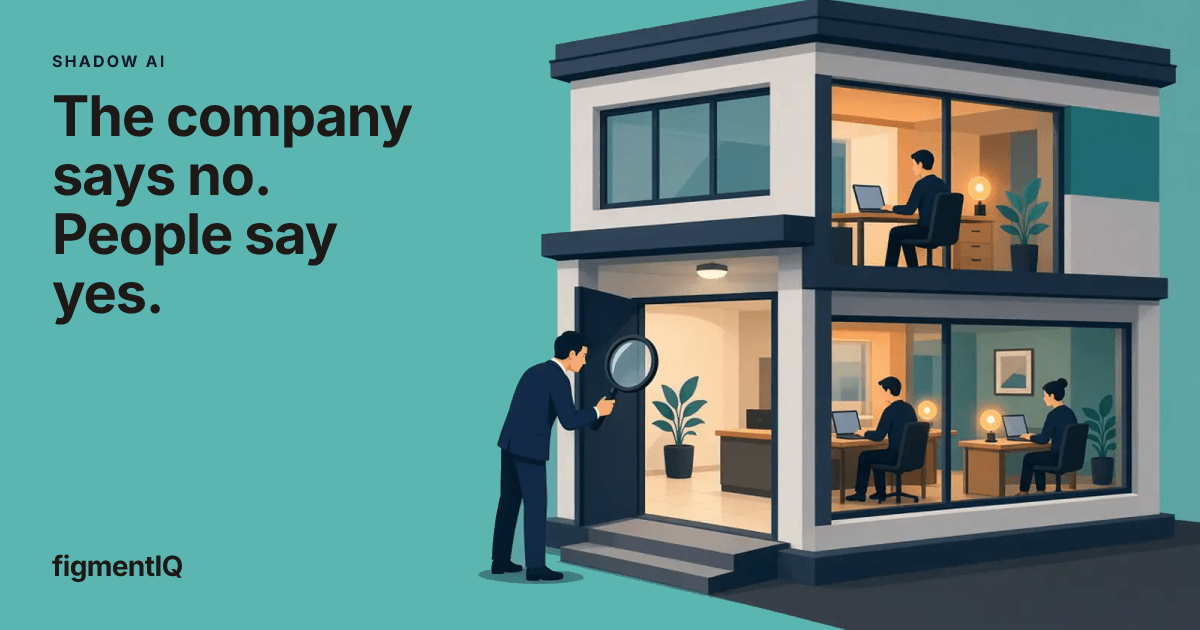
Unsanctioned AI: why 'Do we use AI?' is the wrong question

Picture a Tuesday leadership meeting. A board member asked about AI risk, so the CEO goes around the table: “Do we use AI?” The COO says not really, there was a pilot last year. IT says nothing is approved. HR says the policy is still in draft. Ten minutes later the box is checked: no meaningful AI use.
Down the hall, a recruiter is screening resumes with a chatbot on her personal account. A finance analyst has a prompt library he runs every month-end. The operations coordinator built a small assistant that drafts every vendor follow-up. Nobody asked them.
That’s a hypothetical. The gap in it isn’t. “Do we use AI?” is a question about company programs. Unsanctioned AI, the AI work employees set up on their own, lives somewhere else, and that’s where the key-person risk sits.
The short version:
- “Do we use AI?” usually gets heard as “Do we have an approved AI program?” The honest answer to that is often no, even when employees use AI every day.
- The U.S. Census Bureau hit the same problem in its own business survey: some companies answered no to its AI question, then described AI use in follow-up interviews.
- Surveys of workers find most of them use AI at work, many on tools the company didn’t provide, and many keep it quiet.
- Better questions: who uses AI on their own, what have they built that others rely on, where does it live, and who could run it if they left.
Prefer to watch?
4-minute video
Plays from YouTube. Playing sets YouTube cookies.
We learned this the slightly awkward way
Earlier this fall, we reached out to a few dozen companies about AI continuity. The ones who wrote back to decline all said versions of the same thing: we don’t use AI, not at this level, or regulation limits what we can do.
Every one of those answers was about the company’s AI program. None of them was about what employees were doing on a Tuesday afternoon. Fair enough. That’s the question they heard, so that’s the question they answered. That one’s on us.
Even the Census Bureau got a misleading “no”
The U.S. Census Bureau ran into the same wall with considerably more respondents. Its Business Trends and Outlook Survey used to ask whether a business used AI “in producing goods or services.” In late 2025 it switched to “in any of its business functions,” after testing turned up a problem. In the Bureau’s words, some respondents “answered no to the AI question at first, but further discussion during the interview demonstrated they were using AI,” for things like hiring, project management and accounting (Census Bureau, BTOS AI question updates).
The new wording produced a big enough jump that Census started a new data series rather than stitch the old and new numbers together. Same kind of businesses, different question, different answer.
If a federal statistical agency with a question-testing program can get a misleading “no,” a ten-minute slot on a leadership agenda certainly can.
What happens when you ask employees instead
Ask the people doing the work and the picture flips:
| Finding | Source |
|---|---|
| 58% of employees say they intentionally use AI at work, and almost half admit using it in ways that go against company policy. | University of Melbourne and KPMG, Trust, attitudes and use of AI: a global study 2025 (48,000+ people, 47 countries) |
| 57% of employees say they hide their use of AI and present AI-generated work as their own. Only 40% say their workplace has a policy or guidance on generative AI. | Same study |
| 78% of AI users bring their own AI tools to work, and 52% are reluctant to admit using AI for their most important tasks. | Microsoft and LinkedIn, 2024 Work Trend Index |
Put those next to the leadership meeting. The company says no. The people say yes, quietly. Both are telling the truth about the question they were asked.
Why I care: this is a continuity problem, not just a security one
Most of what gets written about unsanctioned AI is about data leaving the building, and that matters. My worry runs the other direction: work the company depends on that isn’t really the company’s.
When someone builds a prompt library, a custom assistant or a small automation on their own account, they’ve created a little micro department. It has inputs, outputs, and exactly one employee who knows how it works. If that person leaves, the department closes, usually without anyone noticing until the month-end report doesn’t show up.
“Do we use AI?” can’t find that. It’s pointed at the org chart, and the risk is in the work. That’s the thinking behind our approach to scaling AI adoption without single points of failure: more AI use is the goal, as long as it doesn’t all depend on one person.
Four better questions for the leadership table
Swap the yes-or-no for these. None of them requires monitoring anyone.
- Who on your team uses AI on their own for real work? Ask managers to name people, not tools, and make it clear nobody is in trouble. Given how many employees say they hide their AI use, a question that sounds like a crackdown will get “nobody.”
- What have they built that someone else relies on? A shared prompt, an assistant, an automation, a report with an AI step in the middle. If a coworker would notice it missing, it counts.
- Where does it live? Company account, personal account, personal device. This tells you whether you could even get to it.
- Who could run it tomorrow if the builder left today? A name is a good answer. A shrug is your to-do list.
A simple way to record the answers, shown with illustrative rows:
| Person (example) | What they built | Who relies on it | Where it lives | Backup person |
|---|---|---|---|---|
| Recruiter, J. Smith | Resume screening prompts | Recruiting team | Personal chatbot account | None |
| Finance analyst | Month-end variance assistant | Controller | Company account | Not trained yet |
| Ops coordinator | Vendor follow-up automation | Purchasing | Personal account on a work laptop | None |
These rows are illustrative, not from a real company. If your version has a lot of “None” in the last column, you’re normal, and you have your first project. Our AI agent inventory guide covers turning this into a living record, and Shadow AI Discovery is how we do it with a team.
How to ask without it sounding like an audit
The fastest way to get a false “no” from employees is to make the question feel like surveillance. A few things help:
- Ask about tasks, not tools. “What helps you get the weekly report out faster?” gets better answers than “Do you use ChatGPT?”
- Offer amnesty and mean it. The point is to bring useful work onto company accounts, not to punish whoever built it first.
- Have managers ask, not IT. Same question, far less ominous.
- Say why. “We want this to keep working if you’re out for two weeks” is true, and it lands better than any policy citation.
If you’d rather start from the policy side, our post on an AI acceptable use policy that covers continuity has ownership clauses you can borrow.
Quick answers
What is unsanctioned AI? AI tools and AI-built work that employees use for their jobs without company approval or a company account. Personal chatbot accounts, browser extensions, and assistants or automations set up on someone’s own login all count. Our plain-English explainer on shadow AI goes deeper.
Is unsanctioned AI always a problem? No. It often means someone found a faster way to do their job. It becomes a problem when the company relies on it and can’t see it, secure it, or run it without the person who set it up.
Our employees say they don’t use AI. Should we believe them? Believe that it’s their answer to the question as asked. Then ask about tasks instead of tools, with amnesty. Worker surveys suggest a lot of AI use stays quiet unless people feel safe mentioning it.
Ask the better question this month
At your next leadership meeting, skip “Do we use AI?” Ask each leader to name one thing on their team that runs on AI, and who could run it if its builder left. The pause before the answer will tell you a lot.
That question is why we started figmentIQ. If you’d like a second set of eyes, I’m happy to help. Our AI Continuity Assessment covers one department over two weeks, and there’s no charge if we find nothing at risk.