
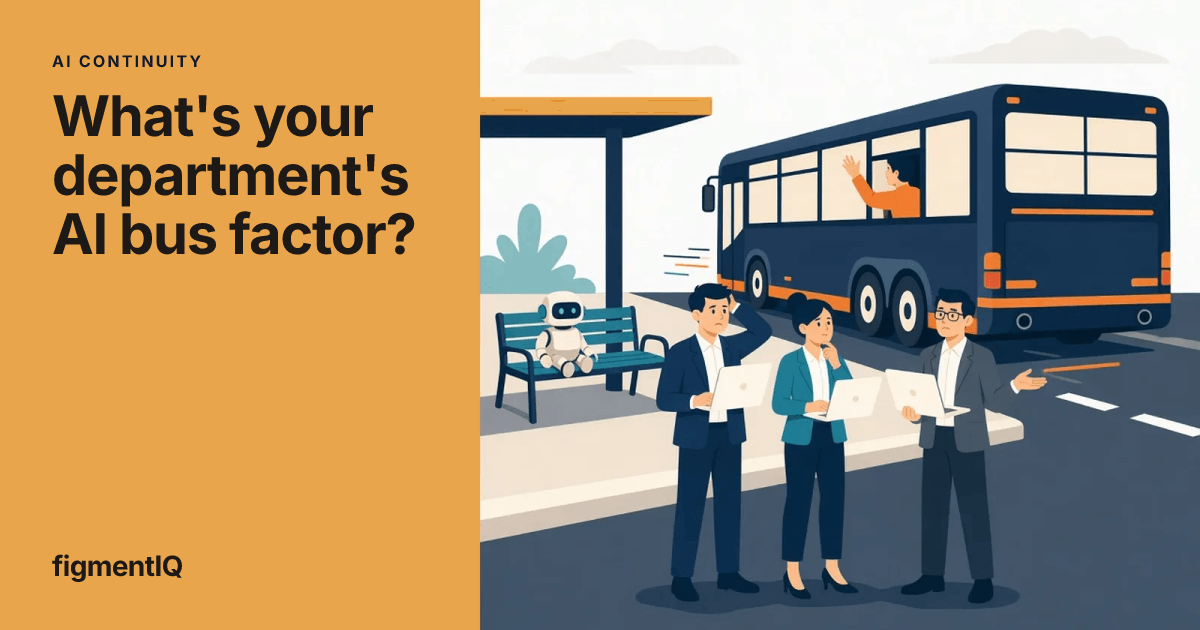
What is your department's AI bus factor?

Picture a Tuesday. Your best operations analyst gives two weeks’ notice. She’s the one who built the weekly vendor scorecard assistant, the onboarding FAQ bot, and the prompt library that drafts half the team’s client emails. HR runs the standard offboarding. IT disables her accounts. On her last Friday, someone asks who else can run those tools.
Silence. Then a shrug. Then a spreadsheet that somehow still has her name in the Owner column.
That’s a hypothetical. The number that describes it isn’t: most departments have an AI bus factor of 1.
The short version:
- A department’s AI bus factor is the smallest number of people who would have to leave before the AI workflows that team relies on stop working, or become unmaintainable.
- In software research, a majority of popular projects score 2 or lower. For department AI work, a score of 1 is the usual starting point.
- Spend 30 minutes with the worksheet below. If you score 1, raise it: name a backup, write a short runbook, and move the work onto a company account before the next resignation.
Prefer to watch?
5-minute video
Plays from YouTube. Playing sets YouTube cookies.
Bus factor, meet the AI department
The term comes from software teams. Researchers often call it the truck factor: the minimal number of people who have to be hit by a truck (or quit) before a project is incapacitated. A 2016 study by Avelino and colleagues estimated truck factors across 133 popular GitHub projects and found that a majority (65%) had a truck factor of 2 or less. That paper is about software authorship, not AI departments. I’m borrowing the idea, not their numbers.
Reframe it for ops and HR: your department’s AI bus factor is how many people can leave before the AI workflows that department depends on stop working. Count the builders and maintainers of the assistants, prompt libraries, automations, and custom GPTs people use every week. Don’t count people who only consume the output. Consumers don’t keep the thing running.
If one person built it, one person can maintain it, and nobody else has a working copy of the instructions, your score is 1. Congrats: you have a hero. Heroes make terrible continuity plans.
Why this number got interesting this year
AI work is no longer a side experiment in one clever corner of the company. Microsoft’s 2024 Work Trend Index, a survey of 31,000 knowledge workers in 31 countries, found that 75% of knowledge workers use AI at work. Of those AI users, 78% bring their own AI tools (BYOAI), and 52% are reluctant to admit using AI for their most important tasks. The work is real, much of it sits on accounts the company doesn’t control, and people aren’t advertising the valuable parts. That’s how you get an AI bus factor of 1 with nothing on the risk register.
Ready.gov’s business continuity planning guidance is blunt about the basics: identify and prioritize potential risks and impacts, then test the plan. An AI bus factor of 1 is a dependency you can identify in an afternoon. Testing it is as simple as asking, “If this person is out for two weeks, who runs the weekly report?”
Why I care about a score of 1
The pattern I keep running into isn’t bad technology. It’s good technology that only one person understands. When that person leaves, it isn’t really an employee walking out. It’s a little micro department walking out with them. Somewhere on the way to AI, a lot of companies quietly lost their process documentation, and nobody filed a ticket.
figmentIQ exists to put that documentation back, before the next resignation does the inventory for you.
A 30-minute AI bus factor worksheet
This is an original worksheet for HR or ops. Fill it for one department. Thirty minutes is enough if you ask the people who do the work, not only the people who approve the tools.
Step 1. List every AI workflow the department uses at least weekly: assistants, custom GPTs, Claude Projects, Copilot or Gemini setups, prompt libraries, and AI-backed automations.
Step 2. For each item, name the primary builder/maintainer and anyone else who could rebuild or run it without calling that person.
Step 3. Score the department:
| Score | What it means |
|---|---|
| 1 | One person leaving breaks or freezes most critical AI workflows |
| 2 | Two specific people would have to leave before the same happens |
| 3+ | Three or more people independently understand and can run the critical set |
Step 4. Mark each critical item as company-account or personal-account. Personal-account items pull your score toward 1; the company can’t inherit what it never owned.
Here is an illustrative sample for a fictional operations team. These are examples, not real data.
| AI workflow (example) | Primary owner | Backup who can run it | Account | Critical? | Notes |
|---|---|---|---|---|---|
| Weekly vendor scorecard assistant | J. Smith | None | Personal | Yes | Leaves with J. Smith |
| New-hire FAQ bot | A. Lee | M. Patel | Company | Yes | Backup trained once |
| Client email prompt library | J. Smith | None | Company | Yes | Shared doc; only J. Smith updates it |
| Meeting-notes summarizer | A. Lee | M. Patel, R. Gomez | Company | No | Nice to have |
In this sample, two of three critical items depend on J. Smith alone. Department AI bus factor: 1.
If your real sheet looks like that, skip the consultant for the punchline. Get a backup and a runbook before J. Smith’s next interview.
How to raise a score of 1
Raising the number is boring on purpose. Boring is how continuity works.
-
Find the work first. You can’t back up what you can’t see. Inventory AI work on company and personal accounts. Shadow AI Discovery describes how we approach that without a gotcha.
-
Name a backup for every critical item. A person, not “the ops team.” Have the backup run it once while the owner watches.
-
Write a one-page runbook. Purpose, where it lives, how to run it, what good output looks like, and how to move it. See Continuity Runbooks.
-
Move personal-account work onto company accounts. Ownership the company can inherit beats heroics that leave with a resignation letter.
-
Wire AI into offboarding. At notice, ask what they used and built, then hand it off while they still answer Slack. Full sequence: employee offboarding checklist, updated for AI.
-
Watch vendor deadlines. Tool retirements turn a quiet bus-factor problem into a calendar invite. Current example: custom GPT retirement.
You don’t need a new platform on day one. You need a named owner, a named backup, and a page someone else can follow on a Monday morning.
Quick answers
What is an AI bus factor? It’s the smallest number of people who would have to leave before a department’s AI workflows stop working or become unmaintainable. A score of 1 means a single departure breaks the critical set.
Is bus factor the same as truck factor? Yes. Software teams use both names for the same idea: how concentrated knowledge is among the people who can keep a system running. The AI version applies that idea to assistants, prompts and automations instead of source code.
How is this different from a normal key-person risk review? Key-person reviews often stop at job titles and access lists. An AI bus factor asks who can rebuild and run the department’s AI work next week, including work on personal accounts.
What’s a good score? Aim for at least 2 on critical AI workflows. A 1 is common and fixable. A 3 beats pretending the hero will stay forever.
How often should we rescore? After any resignation or role change that touches AI work, and at least quarterly. An annual pass is mostly a memorial for last year’s assistants.
If one person left Friday, would Monday still work?
That’s the whole question. Software teams have asked a version of it for years. AI made it urgent for HR and ops, because the “source code” now lives in prompts, personal accounts and half-documented automations.
That question is why we started figmentIQ. If you’d like a second set of eyes, I’m happy to help. Our AI Continuity Assessment takes one department and two weeks. We find the AI work that team relies on, including tools on personal accounts, and show you what would break if a key person left. If we find nothing at risk, you don’t pay.
If you’d rather read first, start with Continuity Runbooks or Shadow AI Discovery.